

We start by finding exactly where your company is losing time, money, and momentum.
Most companies have a people problem that is actually a systems problem.
Before we build anything, we need to understand what is really happening inside your organization – and what it is costing you.
This is not a disruptive audit. We sit down with your leadership team, ask the right questions, and take a clear-eyed look at how your company actually operates day to day. We are looking for the gaps between how things are supposed to work and how they actually work – and we put a number on what those gaps are costing you.
The output is a clear, actionable map of exactly where to focus first.
What we look at — and why it matters.
1.
The Role Reality Gap
What your people are actually doing vs. what you’re paying them to do…
What We Look At
We put your written job descriptions next to what your people actually do every day. Not what the role is supposed to look like – what it actually looks like at 10am on a Tuesday.
These two things are almost never the same. And that gap? That’s where your payroll budget goes to work for the wrong things.
Why It Matters
When a $90,000 employee spends the majority of their day on $20-an-hour tasks because nobody ever properly defined their role, your company is bleeding money and losing momentum at the same time.
This isn’t a people problem – it’s a design problem. Nobody built the role correctly, so nobody can perform it correctly. We find exactly where that’s happening and fix the design.
2.
Who Holds the Keys to Your Operation?
And……what happens to your business if they leave tomorrow?
What We Look At
We find out where your company’s critical knowledge actually lives – in proper documentation, in your systems, or sitting entirely inside the head of one or two people who happen to show up every day.
Most companies already know the answer before we ask. They just haven’t done anything about it yet.
Why It Matters
If the answer is “in someone’s head,” you don’t have a workforce – you have a dependency. One resignation, one health issue, one better offer from a competitor, and that knowledge is gone.
We identify every single point where your operation is that fragile, and we make sure that when we’re done, your company owns what it knows – not just the people who happen to know it.
3.
Does Your Company Have a Management Problem or a Standards Problem?
Usually it’s both – and we find exactly where.
What We Look At
We look at how your leadership team actually measures performance day to day – and whether those measurements are based on clear, defined standards or on gut feeling, personal relationships, and whoever makes the most noise.
We sit in, we observe, and we ask the questions most people are too polite to ask.
Why It Matters
A manager who spends their day putting out fires is not managing – they are surviving. And they will keep surviving, right up until they burn out or leave. The problem is almost never the manager. The problem is that nobody gave them a clear standard to manage to, so they improvise. Every. Single. Day.
We determine whether your company has a management problem, a standards problem, or – as is usually the case – both. Then we tell you exactly where each one lives and what it’s costing your growth.
By the end of Step 1, here is what you will know.
No slide decks. No theoretical frameworks. Just a clear picture of what’s broken, what it’s costing you, and what needs to happen next.
Finding 1 — The Real Price Tag on Your Current Setup
Most clients are surprised. Usually not in a good way.
When we’re done with Step 1, we put an actual dollar figure on what your current situation is costing you. Not a range. Not an estimate. A specific number built from your overlapping roles, your undefined responsibilities, and your workflows that nobody ever properly designed.
Most business owners have a general sense that things aren’t running as efficiently as they should. What they don’t have is a clear picture of what “not efficient” actually costs them every month.
We give them that picture. It is almost always higher than expected – and it almost always makes the decision about what to do next a lot easier.
Finding 2 — Exactly Where Your Managers Are Getting Stuck
Nine times out of ten, it’s not a talent problem. It’s a standards problem.
We show you precisely where your leaders are spending their time reacting to chaos instead of developing their teams and driving results. Not a general observation — a specific breakdown of where management time is going and why.
Here is what we have learned after doing this for 28 years: managers do not fail because they are bad managers. They fail because nobody gave them a clear standard to manage to. So they improvise. They make judgment calls. They put out fires. And they do it every single day until they are exhausted, disengaged, or gone.
We find every place that pattern is happening in your organization and show you exactly what it would take to replace improvisation with a system that actually works.
Finding 3 — Whether You Have a Talent Problem or a Deployment Problem
Before you hire anyone else, you need to know which one you’re dealing with.
We tell you definitively whether your people are in the right roles – doing work that matches their actual capabilities and genuinely moves the business forward. This matters more than most leaders realize, because the answer changes everything about what you do next.
Here is what we see constantly: a company decides it needs to hire because performance is off. So it hires.
Performance stays off. It hires again. Same result. The problem was never a shortage of people – it was that the people already there were deployed incorrectly, managed without standards, and set up to underperform. More hiring does not fix a deployment problem. It makes it more expensive. We tell you which situation you are in before you spend another dollar on recruitment.
What You Walk Away With at the End of Step 1
Not a thick report full of observations you have to figure out yourself. A clear, practical briefing that tells you exactly what is wrong, what it is costing you, and what to do about it – in that order.
You will know exactly where performance is breaking down and why. You will have a real dollar figure on what each friction point is costing your business every month.
You will have a prioritized roadmap – not a wish list – that tells you what to fix first and why that order matters.
Most of our clients tell us the same thing when they see this document for the first time: they knew something was off, but they had no idea it was this specific, or this expensive.
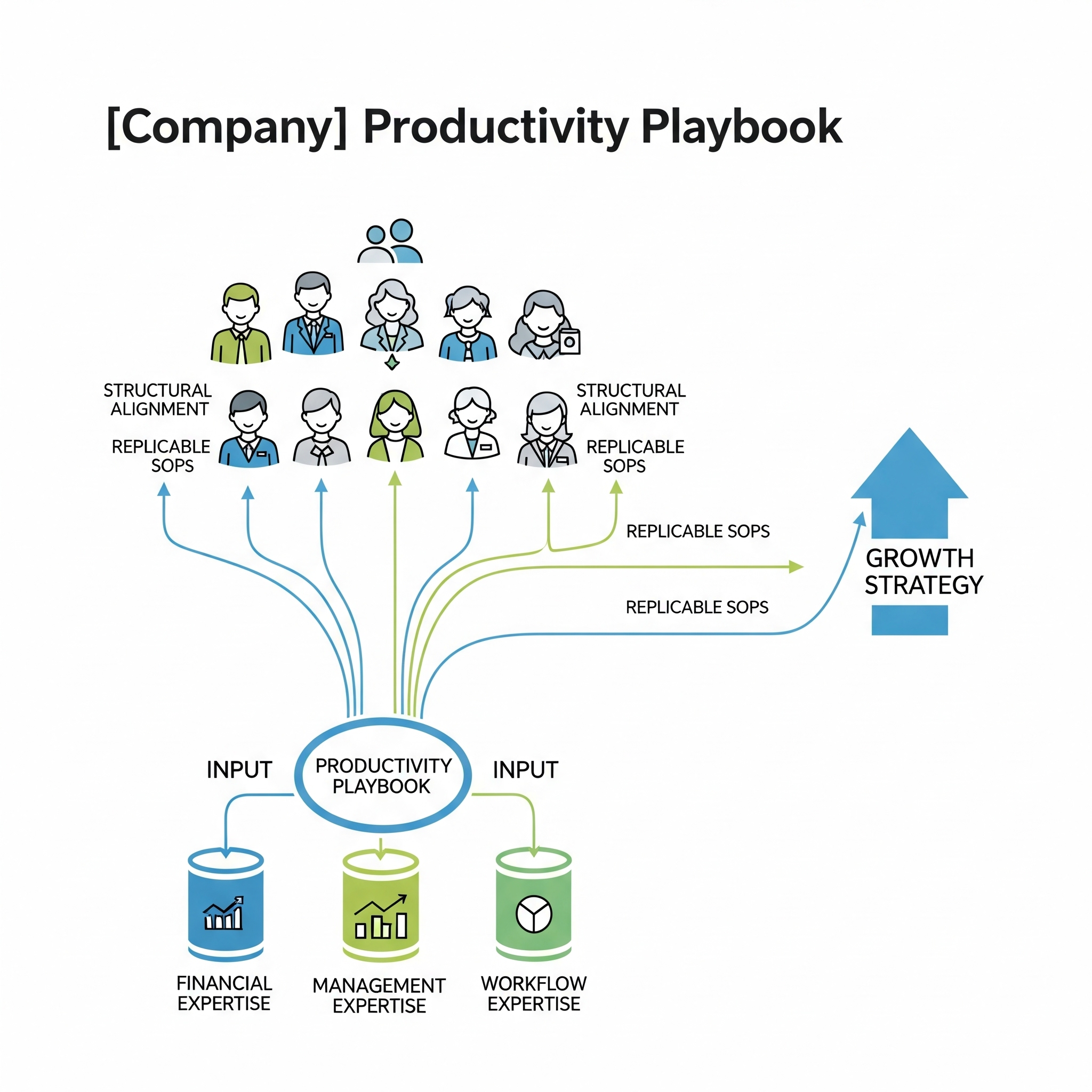
This briefing becomes the foundation for your company’s Productivity Playbook. It is the first time most business owners have ever seen their organization’s actual operational picture laid out clearly in one place – not filtered through someone’s opinion, not softened for political reasons.
Just the truth about how your company is actually running, and a clear path to running it better. That is what Step 1 produces.
Step 2 is where we build the solution.